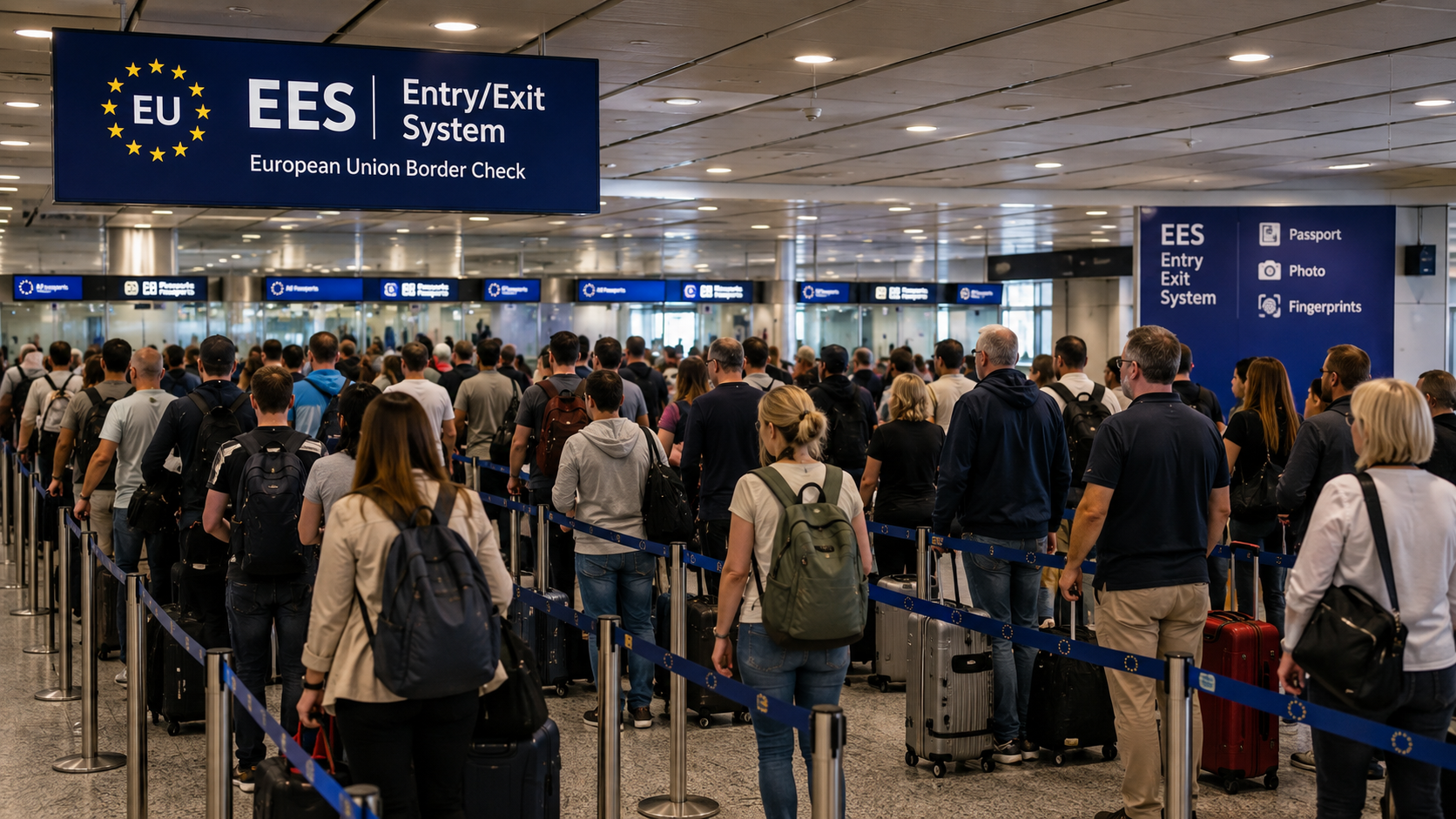
What to Expect at the Border + Where Travelers Are Seeing the Biggest Delays
If you’re traveling to Europe, there’s a good chance you’ll encounter a very different passport-control experience than you did on previous trips.
Europe’s Entry/Exit System (EES) is now fully operational — and while the goal is to modernize and eventually streamline border processing, the rollout has created some very real growing pains.
Long lines, technical problems and missed connections have been reported at some European airports, with recent reports documenting passport-control waits reaching around two hours at major hubs and individual travelers reporting delays of three hours or more.
So what should you actually expect when you arrive in Europe? How does EES work? And which airports have reported some of the biggest delays?
Here’s what travelers need to know.
What Is EES?
The Entry/Exit System, or EES, is Europe’s digital border system for many non-EU travelers visiting countries that participate in EES for short stays.
That includes most American tourists traveling to the Schengen Area.
Instead of relying on traditional passport stamps, EES creates a digital record of your border crossing.
The system records information including:
- Your passport or travel-document information
- Your facial image
- Your fingerprints
- The date and location of your entry
- The date and location of your exit
After a phased rollout that began in October 2025, EES became fully operational at external border crossing points on April 10, 2026.
Do Americans Need to Apply for EES Before Traveling?
No.
This is one of the biggest points of confusion surrounding EES.
EES is not a visa or travel authorization, and there is no EES application you need to complete before your trip.
Your EES registration happens when you cross an external border of a country using the system.
And don’t confuse EES with ETIAS.
EES = the biometric border system already operating now.
ETIAS = a separate pre-travel authorization system that has not launched yet.
The European Commission currently says ETIAS is expected to begin in 2027, although an exact launch date has not yet been announced.
What Happens the First Time You Enter Europe Under EES?
Your first EES experience may take longer because the system needs to create your biometric record.
At the border, expect to:
- Have your passport scanned.
- Have your travel-document information electronically recorded.
- Have a facial image taken.
- Provide fingerprints.
- Complete the normal immigration inspection.
Depending on the airport or border crossing, some of these steps may take place at a self-service kiosk.
Once you’ve been registered in EES, subsequent crossings should generally be quicker because officials can verify you against information already stored in the system instead of creating your biometric record from scratch.
Traveling with kids? Children under age 12 are not required to provide fingerprints, although they are still subject to EES and may have a facial image captured.
Why Has EES Been Causing Long Lines?
EES adds additional steps to a border process that may already be handling thousands of arriving travelers — sometimes from several international flights at once.
First-time biometric registration can take additional time, and technical problems, staffing, the number of available kiosks and the infrastructure at individual airports can all affect how quickly passengers move through passport control.
Recent reporting has documented peak passport-control waits of around two hours at some major European hubs, while individual travelers have reported delays of three hours or more during particularly bad disruptions.
There have also been reports of travelers missing connecting flights after getting caught in lengthy border lines.
But it’s important to put this into perspective:
Not every airport — and certainly not every traveler — is experiencing a two-hour EES line.
Many travelers are moving through EES without major problems, and some border crossings have operated relatively smoothly.
The biggest issue for travelers right now is unpredictability. Wait times can change dramatically depending on the airport, time of day, staffing, arriving flight volume and whether the system is experiencing technical or capacity problems.
Which European Airports Have Reported Some of the Biggest EES Delays?
There is currently no official Europe-wide live ranking of airports by EES wait time, and conditions can change dramatically throughout the day.
However, recent reporting and airport queue data have highlighted several major European hubs where travelers have experienced significant increases in passport-control waiting times.
Frankfurt Airport (FRA)
Frankfurt has been one of the airports attracting attention for EES-related delays.
Recent reporting based on July 2026 wait data showed peak passport-control waits reaching approximately 120 minutes at Frankfurt.
As one of Europe’s largest international connecting hubs, this is an airport where I would be especially cautious about booking a very tight connection that requires you to clear passport control.
Amsterdam Schiphol Airport (AMS)
Amsterdam has also experienced significant passport-control delays.
Recent July data showed peak waits reaching approximately 120 minutes at Schiphol.
This is particularly important for American travelers because Amsterdam is a major gateway between the United States and destinations throughout Europe.
If your itinerary requires you to enter the Schengen Area in Amsterdam before continuing to another Schengen destination, passport control can become a significant part of your connection.
Munich Airport (MUC)
Munich has also been among the major European hubs reporting significantly increased passport-control waiting times since full EES implementation.
Recent reporting indicates that passport-control waits have increased substantially compared with the previous year.
That doesn’t mean you should avoid Munich — but it does mean I’d think carefully before booking a very short connection that requires you to enter the Schengen Area there.
And They Aren’t the Only Airports Having Problems
Travelers at a number of European airports have reported EES-related technical issues, long passport-control lines and inconsistent processing this summer.
Again, that doesn’t mean you’ll automatically encounter a huge wait at one of these airports.
You might breeze through passport control in 15 minutes while another traveler arriving at the same airport during a busy period could face a significant line.
The takeaway isn’t that you should avoid these airports.
It’s that tight connections involving passport control deserve extra consideration right now.
When Do You Actually Go Through EES?
This is another point that can be confusing.
You encounter EES when crossing an external border of the Schengen Area — which means you may go through the process at your connecting airport rather than your final destination.
For example:
San Francisco → Paris → Rome
Paris is your first entry into the Schengen Area, so you would normally go through passport control and EES in Paris.
Once you’ve entered the Schengen Area, your flight from Paris to Rome is traveling within Schengen.
But consider this itinerary:
San Francisco → London → Rome
The United Kingdom is not part of the Schengen Area.
You would therefore continue through London without entering Schengen and encounter EES when you arrive in Rome.
This is why your connection airport can matter just as much as your final destination.
What Is the EES “Off Switch”?
Here’s where things get particularly interesting.
Because EES has caused serious congestion at some borders, the system includes flexibility that allows authorities to temporarily suspend biometric registration in exceptional circumstances when border processing becomes severely congested.
Think of it as an EES “off switch.”
It doesn’t mean the border opens without immigration checks or that EES disappears.
Instead, authorities can temporarily suspend biometric registration requirements to help get passengers moving when queues become overwhelming.
This flexibility has played an important role in preventing even worse congestion at some European borders.
But the “Off Switch” Could Be Changing
The current flexibility is scheduled to expire on September 6, 2026.
Airlines, airports and several European countries have raised concerns about what could happen if border authorities lose that flexibility while EES systems are still experiencing problems.
European officials are now discussing whether that flexibility should be extended beyond September 6, which would continue allowing authorities to temporarily suspend biometric registration when severe congestion occurs.
As of August 25, 2026, however, no final extension has officially been announced.
For now, travelers should plan as though normal EES biometric processing will be operating during their trip.
How to Prepare for EES Before Your Europe Trip
You can’t control how busy passport control will be when your flight arrives, but there are several things you can do to reduce your risk.
Avoid unnecessarily tight connections.
A connection that looked perfectly comfortable a few years ago may feel very different if passport control suddenly takes an hour — or longer.
Know where you enter the Schengen Area.
If you’re connecting in Europe, determine whether you’ll clear immigration at your connecting airport or at your final destination.
Have your passport ready.
Don’t wait until you’re standing at a kiosk or border booth to start digging through your carry-on.
Follow airport signage carefully.
EES procedures and airport layouts vary. Depending on the airport, you may be directed to a self-service kiosk before seeing a border officer.
Give yourself extra time when connecting.
Especially at major international hubs, I would rather build additional connection time into an itinerary than risk watching a connecting flight leave while still standing in passport control.
And remember: a minimum legal connection time isn’t necessarily the connection time I would personally recommend right now. Personally, I’m not booking any connections for clients that are under three hours.
Should You Be Worried About EES?
EES isn’t a reason to cancel — or avoid — a trip to Europe.
Millions of travelers are successfully passing through the system, and plenty are experiencing perfectly normal border waits.
But EES is a reason to plan smarter.
The system is still relatively new, airports are adapting, and some of Europe’s busiest hubs have experienced significant delays.
Knowing where you’ll encounter EES, understanding what happens when you reach the border and allowing additional time — particularly for connecting flights — can make a big difference.
And remember:
EES and ETIAS are NOT the same thing.
EES is already operational.
ETIAS is still to come.
I’ll continue updating this guide as EES procedures change and as we get better information about which European airports are experiencing the biggest delays.
