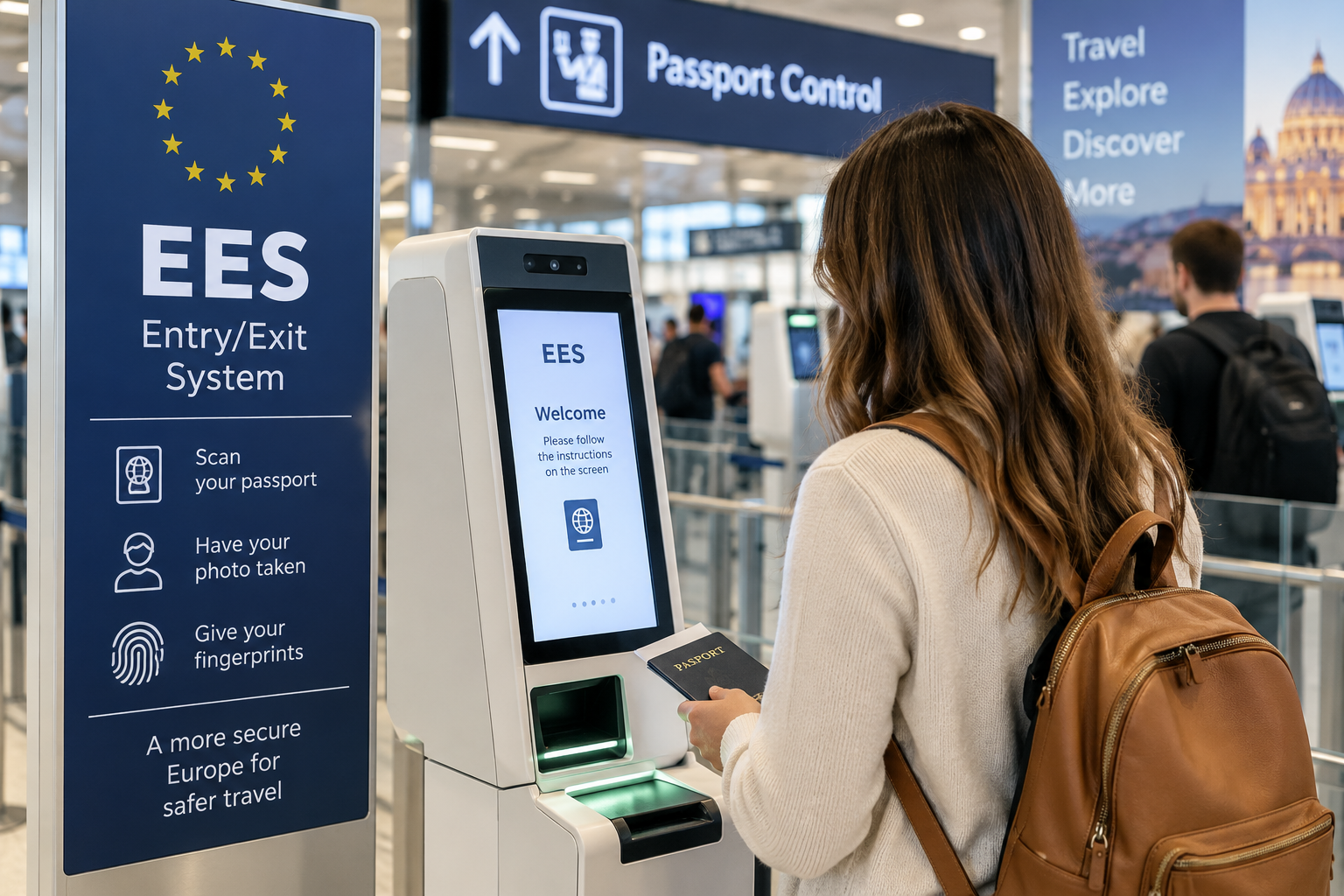
What Travelers Need to Know Right Now
If you’re traveling to Europe soon, you’ve probably heard about EES — Europe’s new biometric Entry/Exit System. The system is now fully operational, but months after its rollout, the experience at European borders is still far from predictable.
Some travelers are getting through passport control relatively quickly. Others are reporting waits of an hour, two hours or more, along with malfunctioning kiosks, manual processing and confusing lines. And a recent development involving nine European countries means the way EES is being handled may continue to vary depending on where — and even when — you enter Europe.
Here’s what travelers need to know right now.
First, What Is EES?
EES stands for the Entry/Exit System. It is Europe’s new automated border system for many non-EU travelers entering the Schengen Area for a short stay, including American travelers.
Instead of relying on passport stamps to keep track of when travelers enter and leave, EES electronically records information including your passport details, the date and location of your entry and exit, and biometric information such as your facial image and fingerprints. EES began rolling out in October 2025 and became fully operational at external Schengen border crossing points on April 10, 2026.
There is nothing Americans need to apply for before their trip in order to use EES. The process takes place as part of border control when you enter or leave the Schengen Area.
So, What Changed in September?
September 6, 2026 was supposed to mark the end of an important period of flexibility built into the EES rollout.
During the transition, border authorities had the ability in exceptional circumstances to temporarily suspend some biometric collection when EES was causing excessive congestion. Think of it as a pressure-release valve: if fingerprint and facial-image processing was creating unmanageable lines, authorities had some flexibility to keep passengers moving.
That temporary period was due to end on September 6. But nine countries had already raised concerns about what would happen if that flexibility disappeared while airports and other border crossings were still experiencing significant EES problems. Those nine countries are:
France, Germany, Italy, Greece, Portugal, Belgium, the Netherlands, Malta and Switzerland.
Authorities in these countries have continued to receive some flexibility in how biometric processing is handled when EES creates serious operational problems. That does NOT mean EES has been suspended in these countries, and it does not mean travelers can expect to bypass EES. It means that when congestion or technical problems become severe, some border authorities may be able to modify or temporarily suspend parts of the biometric collection process to keep people moving.
For travelers, the biggest takeaway is simple: the EES experience is still not consistent.
What Does EES Actually Look Like at the Airport?
For most American travelers flying to Europe, EES comes into play when you reach passport control at your first entry into the Schengen Area. If you are registering in the system, you may need to have your passport scanned, provide a facial image and have fingerprints collected. Depending on the airport, some of this process may take place using self-service kiosks before you proceed to a border officer.
And this is where some of the problems have occurred. EES was designed to eventually make European border processing more efficient, but adding biometric registration to millions of travelers has created bottlenecks at some airports. Technical problems with kiosks, staffing, passenger volume and the number of international flights arriving at the same time can all affect how quickly the line moves.
So while one traveler might have a relatively uneventful experience, another traveler arriving at the same airport on a different day — or even at a different time that same day — can have a completely different experience.
Why Are Some Travelers Still Waiting So Long?
This is probably the most important thing to understand about EES right now: there isn’t one standard wait time you should expect.
I recently spoke with a traveler who arrived at Charles de Gaulle Airport in Paris and waited more than two hours to get through the process. She encountered kiosks that weren’t functioning properly, travelers who couldn’t get through the automated process and people being redirected for manual processing. Her description of the experience? Chaos.
Meanwhile, other travelers are reporting much quicker experiences at the very same airport.
Your experience can depend on the airport, terminal, staffing levels, how many international flights have just landed, whether the kiosks and technology are working properly and how border officials are managing EES at that particular moment. That’s why I wouldn’t base your plans on someone saying, “I flew through Paris last week and it only took me 20 minutes.” That may be exactly what happens to you. It also might not.
Be Especially Careful With Connecting Flights
This is where EES delays can become more than an inconvenience. If you’re flying from the United States to another destination within the Schengen Area, you will generally complete immigration at your first Schengen entry point — not necessarily your final destination.
For example, if you’re flying:
San Francisco → Paris → Rome
Paris is your first entry into the Schengen Area, so that’s where you would go through passport control before continuing to your flight to Rome.
Likewise:
Houston → Frankfurt → Florence
You would generally complete immigration in Frankfurt. That makes the length of your connection particularly important. An airline may sell you a connection that technically meets the airport’s minimum connection time, but that doesn’t mean I’d necessarily be comfortable booking it while EES processing remains this unpredictable. A long delay at passport control can turn a perfectly legal connection into a very stressful one.
How Much Connection Time Should You Allow?
Unfortunately, there isn’t one connection time that works for every airport and itinerary. The airport, terminal changes, airline, routing and how busy passport control is when you arrive can all make a difference. Personally, while EES processing remains this unpredictable, I am not booking my clients on connections of less than three hours when they need to clear immigration at their first Schengen entry point.
That doesn’t mean you’ll need three hours. You may arrive, get through passport control quickly and have plenty of time to spare. But we’ve also seen travelers encounter waits of an hour, two hours or more, and there’s simply no reliable way to know what the situation will look like when your flight lands. I’d much rather build extra time into an itinerary and have my clients sitting comfortably at the gate with a coffee than worrying about missing their next flight because passport control took significantly longer than expected.
So when you’re looking at flights to Europe, don’t just look at whether the airline will sell you the connection. Pay attention to where you’ll first enter the Schengen Area and how much time you actually have to get through immigration and make your onward flight.
What Can You Do Before Your Trip?
You can’t control how long the EES line will be when you land, but you can plan around some of the uncertainty. Know where you first enter the Schengen Area and don’t assume immigration happens at your final destination. Be cautious about short connections after that first entry. Make sure your passport meets the entry requirements for your destination, and pay attention to information from your airline and arrival airport before you travel.
Most importantly, go into it knowing that EES may add time to the process. You could get through quickly, or you could encounter a significant delay. Planning for the second scenario makes the first one a pleasant surprise.
What If I’ve Already Registered With EES?
The initial EES registration is generally the most involved because that’s when your biometric information is collected and your record is created. On subsequent trips, your information can be checked against the data already stored in EES rather than starting the entire registration process from scratch. However, that doesn’t mean you can assume you’ll breeze through passport control on your next trip.
You are still crossing an external Schengen border, and congestion, technology issues and passenger volume can still affect your wait.
EES and ETIAS Are NOT the Same Thing
This continues to cause a lot of confusion. EES is the border system. You don’t submit an EES application before your vacation. The system records eligible non-EU travelers when they cross Europe’s external borders. ETIAS is a future travel authorization. Once it launches, visa-exempt travelers — including Americans — will generally need to obtain authorization before traveling to participating European countries.
And there’s been another important update here: ETIAS is not launching in 2026 as previously expected. Recent reporting has pushed the expected launch into 2027 or potentially later. The European Union currently says ETIAS is not operational, no applications are being accepted, and an official start date will be announced several months before the system goes live. So if you’re traveling to Europe right now, you do NOT need to apply for ETIAS.
Be careful with websites offering to sell you an ETIAS authorization today. There is currently no ETIAS application to submit.
Does EES Change Europe’s 90-Day Rule?
No. The basic short-stay rule hasn’t changed. For Americans and many other visa-exempt travelers, visits to the Schengen Area are generally limited to 90 days within any rolling 180-day period. What EES changes is how those days are tracked. Instead of relying primarily on passport stamps, the system electronically records entries and exits, making it easier for authorities to determine how long a traveler has been within the Schengen Area.
If you’re spending an extended amount of time traveling around Europe, it’s still a good idea to keep your own records of your travel dates, flights and accommodations.
I’ll continue updating this guide as EES evolves and, eventually, as ETIAS gets closer to launching, so bookmark this page before your next trip to Europe.
